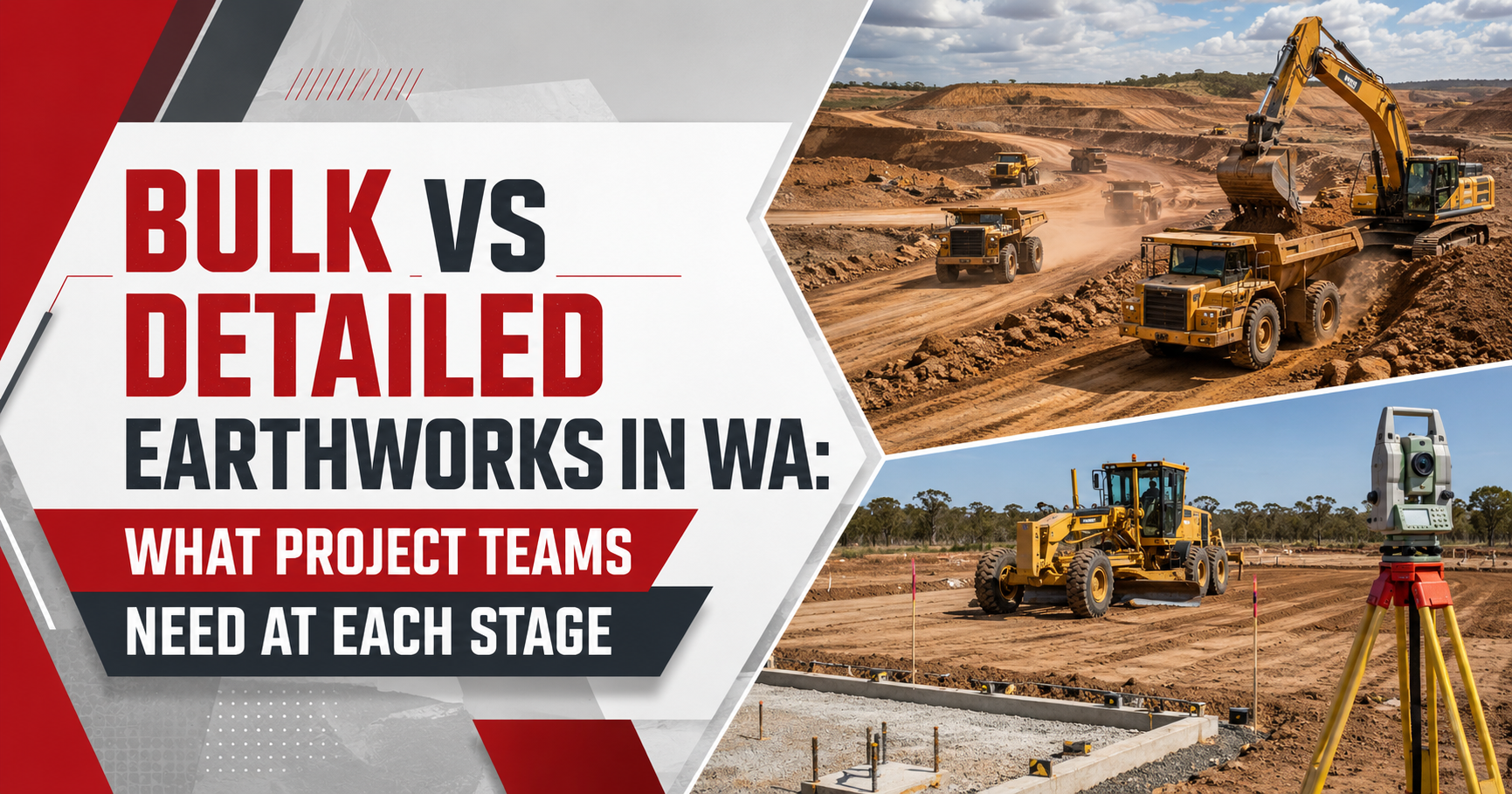
Bulk vs Detailed Earthworks in WA: What Project Teams Need at Each Stage
Earthworks can look straightforward from a distance.
Excavate material. Move it. Place it. Compact it.
But on a civil, mining or infrastructure project, successful earthworks involve much more than moving soil from one part of the site to another.
Levels need to be accurate. Materials need to be suitable. Drainage needs to be considered. Haul routes need to work. Foundations need to be prepared correctly. And every stage needs to support the construction activity that follows.
This is why bulk & detailed earthworks should be planned as one connected construction process.
Bulk earthworks establish the major shape and formation of the project site.
Detailed earthworks then bring specific areas to the level and accuracy required for roads, structures, drainage, utilities, foundations and other infrastructure.
For project teams looking for reliable bulk earthworks services WA, understanding the difference between these two stages can help improve planning, material movement and overall project delivery.
What Is Bulk Earthworks?
One of the most common questions project teams ask is: what is bulk earthworks?
Bulk earthworks refers to the large-scale excavation, movement, placement and compaction of soil, rock or suitable fill required to establish the main profile of a project site.
Depending on the project, bulk works can include:
- Site clearing and preparation
- Mass excavation
- Bulk cut and fill
- Building and equipment pads
- Large-scale site grading
- Road formations
- Embankments
- Material placement
- Compaction
- Stockpile management
- Removal of unsuitable material
The objective is not simply to move the largest possible volume of material.
The goal is to achieve the required site formation efficiently while preparing the project for the next stage of construction.
Core Civil Mining provides Bulk & Detailed Earthworks for civil, mining and infrastructure projects across Western Australia.
What Are Detailed Earthworks?
Detailed earthworks begins when greater accuracy is required.
Instead of concentrating primarily on large material volumes, the focus moves toward specific construction areas and finished levels.
Detailed earthworks may involve:
- Detailed excavation
- Site leveling and grading
- Foundation preparation
- Final trimming
- Structural pads
- Drainage channels
- Service trenches
- Batter formation
- Utility corridors
- Backfilling
- Subgrade preparation
A bulk earthworks operation may create the overall platform.
Detailed earthworks makes individual sections of that platform ready for the activity that comes next.
For example, concrete contractors cannot simply compensate for an incorrectly prepared foundation area.
Road crews should not need to correct major formation problems after pavement works have started.
Good civil earthworks therefore needs both productive bulk movement and controlled detailed finishing.
Bulk vs Detailed Earthworks: What's the Real Difference?
The simplest difference is:
Bulk earthworks = volume and overall formation
Detailed earthworks = precision and final preparation
Imagine a large industrial development.
The first stage may require thousands of cubic metres of material to be excavated and redistributed across the site.
That is bulk earthworks.
Once the major levels have been established, smaller areas may need to be prepared accurately for:
- Concrete foundations
- Roads
- Drainage infrastructure
- Building pads
- Utility trenches
- Equipment foundations
That is detailed earthworks.
Neither stage should be considered independently.
A strong earthworks methodology connects them.
Stage 1: Understand the Site Before Excavation Begins
Earthworks planning should start before heavy equipment is mobilised.
The project team should understand:
- Existing ground levels
- Design levels
- Geotechnical conditions
- Material types
- Drainage paths
- Existing underground services
- Access constraints
- Environmental requirements
- Future work areas
- Haul routes
- Stockpile locations
These factors influence both production and sequencing.
If the project team begins excavating without understanding where material needs to end up, unnecessary handling can follow.
Stage 2: Plan Cut and Fill Properly
Another common earthworks question is: what is cut and fill?
Cut and fill is a construction method where material is excavated from areas that are above the required design level and suitable material is placed in areas that need to be raised.
For example:
An elevated area may require excavation.
A nearby low section may require fill.
If the excavated material is suitable for reuse, it may be transferred from the cut area to the fill area.
The process can reduce unnecessary disposal and imported material requirements.
However, not every excavated material is automatically suitable for fill.
Project specifications, material condition, moisture, compaction requirements and engineering requirements still need to be considered.
A good cut-and-fill strategy should answer four questions:
Where is the material coming from?
Where does it need to go?
Is it suitable for the intended use?
When does the receiving area need it?
Poor answers to these questions can create unnecessary project costs.
Stage 3: Control Material Movement
Large earthworks productivity depends on more than excavation speed.
Think about the complete cycle:
Excavate → Load → Haul → Place → Grade → Compact → Verify
Every stage affects the next one.
An excavator can load quickly, but if trucks cannot clear the loading zone efficiently, production slows.
Additional trucks do not necessarily solve the problem if:
- Haul routes are congested
- Tipping areas are too small
- The receiving area cannot place material quickly enough
- Stockpiles are positioned poorly
- Plant movements interfere with other work
Material management is therefore one of the most important elements of successful earthworks.
Stage 4: Site Leveling and Grading
Once major cut-and-fill activities are progressing, the project needs to move toward its design profile.
Site leveling and grading helps establish:
- Building pads
- Structural areas
- Road formations
- Hardstands
- Drainage falls
- Pavement areas
- Access routes
- Equipment pads
Accuracy matters because small level differences can affect later stages of construction.
Grading also needs to consider water movement.
A site can look perfectly smooth but still perform poorly if rainfall is unintentionally directed toward excavations, foundations or traffic areas.
That is why drainage planning should be coordinated with civil earthworks rather than treated as a separate late-stage task.
Stage 5: Plan Drainage During Earthworks
Water management can affect access, ground conditions and completed earthworks.
Depending on the project, drainage planning may include:
- Surface drains
- Culverts
- Diversion channels
- Stormwater systems
- Trenching
- Subsoil drainage
- Sediment controls
- Dewatering
- Grading to controlled outlets
Core Civil Mining also provides Dewatering & Drainage services across civil and mining project environments.
Drainage should ideally be considered before major site areas are finished.
Otherwise, completed earthworks may need to be excavated again to install drainage infrastructure.
Where Does a French Drain System Fit Into Civil Earthworks?
A french drain system is one type of subsurface drainage solution used to manage groundwater or surface water in appropriate applications.
Typically, the system includes:
- A trench
- Free-draining aggregate
- A perforated drainage pipe
- Geotextile or filter material where required
- An outlet or discharge point
The surrounding aggregate allows water to enter the trench, while the pipe helps carry collected water away.
A French drain is not automatically the correct solution for every civil or mining project.
Drainage design depends on factors including:
- Soil conditions
- Water volumes
- Ground levels
- Project specification
- Discharge location
- Environmental requirements
The drainage system needs to fit the actual site conditions.
Drainage Pipe and French Drain Installation
People sometimes search for terms such as drainage pipe french drain when trying to understand how these systems work.
In practice, the pipe forms only one component of the complete drainage system.
A typical installation requires consideration of:
- Trench location
- Trench depth
- Required fall
- Pipe specification
- Aggregate
- Geotextile
- Discharge location
- Future maintenance
The pipe should be installed so collected water can move toward an appropriate outlet.
Poor levels or an unsuitable discharge point can reduce the effectiveness of the entire system.
How Does a French Drain Drainage Pipe Work?
The phrase french drain drainage pipe generally refers to the perforated pipe installed within the drainage trench.
Water enters through the surrounding free-draining material and then moves into the perforated pipe.
The pipe carries water toward a suitable outlet.
The important point for project teams is that drainage performance depends on the complete installation.
Pipe size alone does not determine whether the drainage system will work.
Trench geometry, levels, aggregate, filter material, outlet location and surrounding ground conditions all matter.
For larger civil and mining projects, drainage may also require culverts, open channels, sediment basins, pumping systems or other engineered water-management solutions.
Stage 6: Prepare the Subgrade
What sits below the finished pavement, road or structure has a major influence on what happens above it.
Depending on project requirements, subgrade works can include:
- Removal of unsuitable material
- Reworking existing material
- Moisture conditioning
- Compaction
- Placement of suitable material
- Stabilisation
- Final trimming
- Survey verification
Trying to compensate for a weak formation with additional material above it may create problems later.
Good earthworks establishes the correct platform before subsequent layers are constructed.
Main Roads Western Australia's earthworks requirements demonstrate the importance of constructing road earthworks to nominated levels, profiles and surface requirements.
View Main Roads WA Technical Specifications
Stage 7: Move Into Detailed Foundation Preparation
Once major earthworks have established the site's overall levels, the work becomes more precise.
Foundation preparation can involve local excavation and detailed trimming around:
- Concrete footings
- Equipment foundations
- Building pads
- Retaining structures
- Structural slabs
- Pavement interfaces
This is where good coordination between earthworks crews, surveyors, engineers and following trades becomes particularly important.
The aim should be to hand over an area that is ready for the next activity.
Not an area that still needs significant correction.
Stage 8: Coordinate Trenching and Utilities
Infrastructure projects often require underground services after or during earthworks.
These may include:
- Drainage pipes
- Electrical services
- Water lines
- Communications
- Sewer infrastructure
- Process piping
If these corridors are not considered during bulk earthworks, completed areas may need to be reopened.
Early trench and service planning can reduce unnecessary disturbance.
Safe Work Australia's guidance for excavation work covers risk management associated with trenches and bulk excavations.
Read Safe Work Australia's Excavation Work Guidance
Stage 9: Use GPS Machine Control Where Appropriate
Modern civil earthworks Perth and broader Western Australian project delivery increasingly uses digital machine-control technology.
Core Civil Mining's capability includes a GPS machine-controlled fleet.
Depending on the project and equipment configuration, GPS machine control can support:
- Cut and fill
- Large-area grading
- Road formations
- Building pads
- Excavation depths
- Batters
- Design surfaces
GPS technology can help operators work toward digital project designs more efficiently.
However, it does not replace:
- Skilled operators
- Survey controls
- Engineering requirements
- Quality verification
The strongest outcome comes from combining experienced people with accurate digital information.
Earthworks for Mining Projects
Western Australian mining projects often require substantial earthmoving capability.
Applications can include:
- Mine site preparation
- ROM pads
- Haul roads
- Tailings infrastructure
- Plant areas
- Drainage
- Pit infrastructure
- Structural pads
- Access roads
Remote project environments can add logistical considerations including:
- Plant mobilisation
- Fuel
- Water
- Workforce
- Maintenance
- Spare parts
- Material sources
Core Civil Mining supports the Mining Industry with civil contracting and supporting infrastructure capability.
Civil Earthworks Across Perth and Western Australia
Project requirements vary significantly between metropolitan and remote environments.
For civil earthworks Perth, projects may involve:
- Commercial site preparation
- Industrial development
- Roads
- Drainage
- Building pads
- Utilities
- Concrete preparation
- Land development
Remote WA projects may require larger mobilisation planning and heavier mining infrastructure capability.
This is why choosing an earthworks contractor should not be based only on equipment availability.
The contractor needs to understand the actual project environment.
Explore the different sectors supported by Core Civil Mining through the Industries page.
What Should You Look for in Bulk Earthworks Services WA?
When evaluating bulk earthworks services WA, consider more than the plant list.
A capable earthworks contractor should demonstrate strength across:
Planning
Can the contractor understand design levels, construction sequencing and material movements?
Bulk production
Can the fleet move the required volumes efficiently?
Detailed work
Can the same project progress into accurate grading, foundations, drainage and trench preparation?
Material management
Can suitable material, unsuitable material and stockpiles be controlled effectively?
Drainage
Is water management considered during the construction process?
Technology
Can GPS machine control or other project systems support accuracy where required?
Safety
Are mobile plant, excavation and traffic risks actively managed?
Project coordination
Can earthworks support rather than disrupt the next construction stage?
The cheapest hourly rate does not necessarily create the lowest overall project cost.
Double handling, rework and poor sequencing can quickly remove any initial saving.
Common Earthworks Mistakes That Create Rework
Starting Without a Material Plan
Moving material before determining where it ultimately needs to go can create unnecessary haulage.
Ignoring Drainage Until Late
Installing drains after finished earthworks can require completed areas to be disturbed again.
Poor Stockpile Locations
A temporary stockpile can become an expensive problem if future construction needs the same area.
Rushing the Subgrade
Problems below roads or structures can affect the layers above them.
Separating Bulk and Detailed Works
Bulk earthworks should create the conditions needed for detailed works.
Focusing Only on Production
Fast excavation does not automatically mean efficient project delivery.
Plan Earthworks Around What Happens Next
The best earthworks strategy is not simply the one that moves material fastest.
It is the one that prepares the project properly for everything that follows.
Bulk works should establish the overall formation.
Detailed works should prepare specific areas accurately.
Drainage should protect completed earthworks.
Cut-and-fill planning should reduce unnecessary material movements.
Subgrade preparation should support the infrastructure above it.
And site sequencing should allow construction to progress without repeatedly reopening completed areas.
That is what separates basic earthmoving from professional bulk & detailed earthworks delivery.
Planning Bulk or Detailed Earthworks in WA?
Core Civil Mining supports civil, mining, industrial and infrastructure projects across Western Australia.
Project capability includes:
- Bulk excavation
- Cut and fill
- Site grading
- Foundation preparation
- GPS-controlled earthmoving
- Trenching
- Drainage
- Road formation
- Mining infrastructure
Explore Core Civil Mining's capabilities or Request a Quote for your upcoming project.
Frequently Asked Questions
What is bulk earthworks?
Bulk earthworks involves the large-scale excavation, movement, placement and compaction of soil, rock or fill to establish the main levels and formations required for a civil, mining or infrastructure project.
What is cut and fill?
Cut and fill is an earthworks method where material is excavated from higher areas and suitable material is placed in lower areas to achieve the required project levels.
What is the difference between bulk and detailed earthworks?
Bulk earthworks focuses on large-scale material movement and overall site formation. Detailed earthworks focuses on more precise work including foundations, drainage, trenches, grading and structural preparation
What is included in civil earthworks?
Civil earthworks can include excavation, cut and fill, grading, compaction, site preparation, subgrade works, drainage, trenching, building pads and road formations.
What are bulk earthworks services WA projects likely to include?
Depending on the project, bulk earthworks services may include mass excavation, material haulage, cut and fill, road formations, grading, compaction, stockpile management and site preparation.
What does civil earthworks Perth usually involve?
Perth civil earthworks can support commercial developments, industrial projects, roads, drainage, land development, utilities, building pads and other infrastructure works.
What is a French drain system?
A French drain system is a subsurface drainage arrangement that generally uses a gravel-filled trench and perforated pipe to collect and redirect water away from an area.