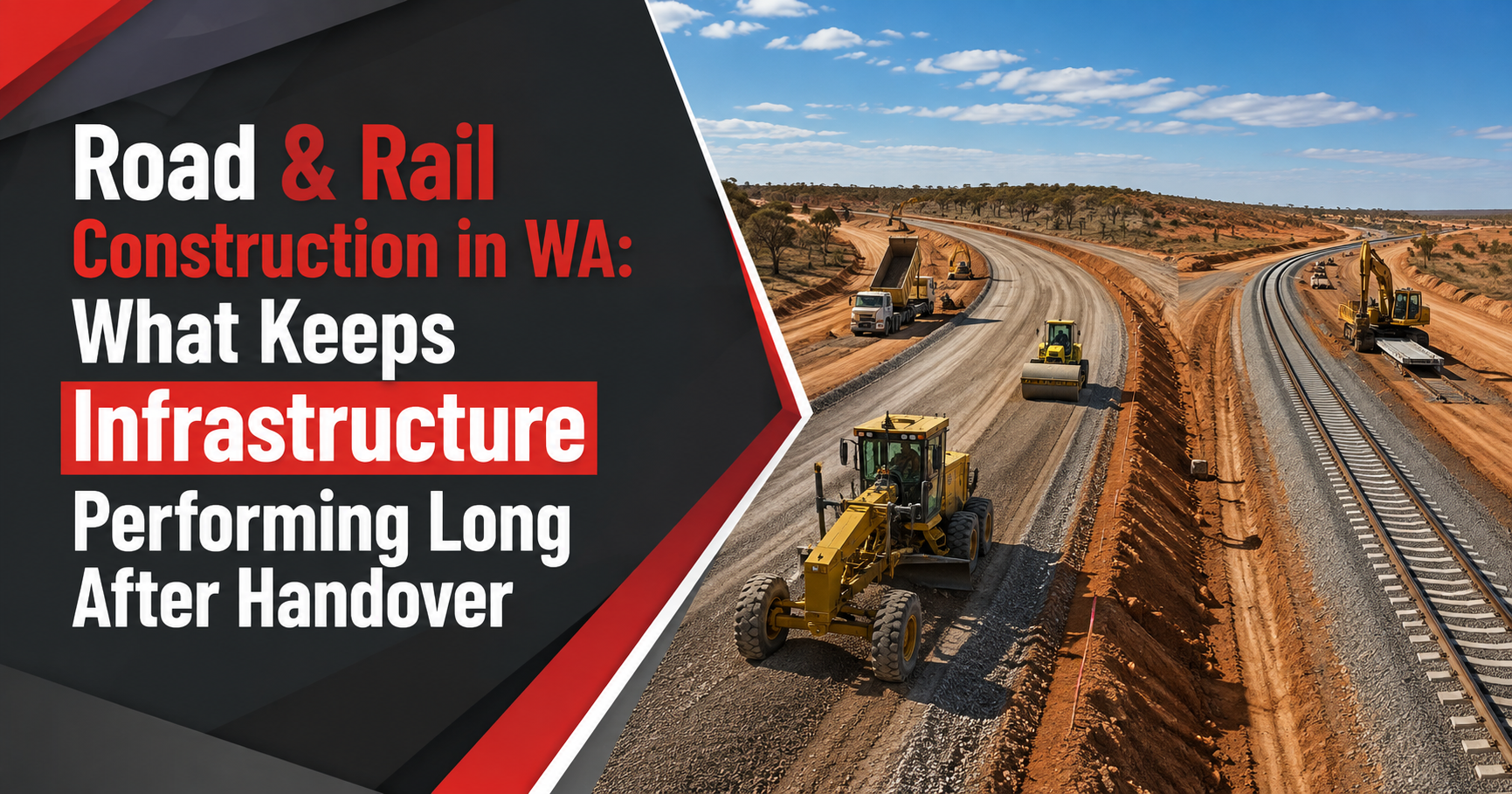
Road & Rail Construction in WA: What Keeps Infrastructure Performing Long After Handover
A road can look finished on handover day and still become a problem months later.
The same is true for rail formations.
Visible surfacing is only the final part of an infrastructure system that depends on what sits underneath it: earthworks, subgrade preparation, drainage, material selection, compaction, levels and construction sequencing.
For mining, civil and infrastructure projects across Western Australia, successful road & rail construction is therefore less about creating a smooth-looking surface and more about building each layer to support what the asset will be required to do.
A remote mine haul road carrying loaded trucks every day has very different demands from a temporary construction access road.
A rail formation has different tolerances again.
Understanding those demands before construction begins can make the difference between infrastructure that simply gets completed and infrastructure that continues performing.
Road Construction Starts Below the Road
When people think about road construction, they often picture graders, rollers and finished pavement.
But the road begins much deeper.
Before pavement layers are placed, teams may need to complete:
- Clearing and site preparation
- Bulk excavation
- Cut and fill
- Formation preparation
- Subgrade treatment
- Drainage installation
- Material placement
- Moisture conditioning
- Compaction
- Grading
- Survey verification
These early works determine the platform on which the finished road will depend.
Main Roads Western Australia's earthworks specification describes road earthworks in terms of constructing required profiles, levels and surface finishes.
That principle is important across both public infrastructure and private civil works.
A road is only as reliable as the formation supporting it.
For projects requiring integrated earthworks before road construction, explore Core Civil Mining's civil and mining capabilities.
1. Heavy Haul Roads Need to Be Designed Around Real Operations
A mine haul road does not experience normal road traffic.
Large mining vehicles create substantial loads and operate repeatedly across the same routes.
That changes the construction priorities.
Effective heavy haul road construction needs to consider factors such as:
- Expected vehicle types
- Loaded vehicle weights
- Traffic frequency
- Turning areas
- Road widths
- Gradients
- Intersections
- Surface material
- Drainage
- Dust
- Maintenance access
- Visibility
A road that technically connects Point A to Point B may still create operational problems if it does not suit the equipment using it.
For example, inadequate road width or turning geometry can affect vehicle interaction.
Poor drainage can soften pavement areas.
An unsuitable surface can increase dust, corrugation or maintenance requirements.
This is why haul-road construction should be considered part of the operating system of a mine, not simply a civil structure.
WorkSafe WA's guidance for roads and traffic management at Western Australian mines specifically considers risk management, road design and maintenance standards, traffic management and powered mobile plant. Read WorkSafe WA's Road and Traffic Management at Western Australian Mines guidance.
2. Earthworks and Road Construction Should Be Planned Together
One of the easiest ways to create unnecessary rework is to separate road planning from the broader earthworks methodology.
Imagine completing bulk earthworks and later discovering:
- the haul road requires additional excavation;
- drainage needs to cross a finished formation;
- unsuitable material exists below the proposed pavement;
- access grades need modification;
- stockpiles are blocking future road alignments.
The project then pays to disturb work that has already been completed.
A stronger sequence may look like:
Survey → Bulk Earthworks → Formation → Drainage → Subgrade → Pavement Layers → Grading → Compaction → Surfacing → Verification
The exact process changes from project to project, but the principle remains consistent.
Each stage should prepare for the next.
Core Civil Mining supports earthworks alongside road, drainage and broader infrastructure packages, helping reduce unnecessary interfaces between separate construction activities.
Learn more about the sectors supported through the Core Civil Mining industries page.
3. The Subgrade Is Doing More Work Than Most People See
The finished road surface receives attention.
The subgrade carries the consequences.
Before pavement construction progresses, the underlying formation needs to provide suitable support for the layers above.
Depending on ground conditions and engineering requirements, preparation can include:
- Removing unsuitable material
- Scarifying existing material
- Moisture conditioning
- Compaction
- Importing suitable fill
- Stabilisation
- Trimming to design level
If a weak area is ignored during construction, adding more material above it does not necessarily solve the underlying problem.
The aim is to build from a suitable platform upward.
This is especially important where roads will experience frequent heavy loads.
4. Pavement Layers Need More Than Material Placement
Delivering pavement material to the site is only the beginning.
Successful pavement construction requires control over:
- Material specification
- Layer thickness
- Moisture
- Grading
- Compaction
- Finished level
- Surface shape
- Drainage
This is where pavement grading & sealing becomes part of a much broader quality process.
A grader can create the required profile, but the material below still needs to perform.
Main Roads WA's pavement specifications cover the construction of granular pavement layers, including modified and stabilised layers, reinforcing the importance of controlled material and construction requirements.
Explore Main Roads WA pavement and earthworks specifications.
5. Drainage Can Determine How Long a Road Performs
Water is one of the biggest variables affecting earthworks and pavement performance.
If water remains within or beside a road formation, it can affect supporting materials and create maintenance issues.
Road drainage may involve:
- Crossfalls
- Table drains
- Culverts
- Catch drains
- Diversion drains
- Subsurface drainage
- Stabilised outlets
- Erosion controls
The objective is to move water away from critical pavement areas in a controlled way.
This becomes particularly important in remote environments where damaged access can disrupt more than normal traffic.
A mining haul road, for example, may connect operational areas, processing infrastructure, workshops or material stockpiles.
If that route becomes unavailable, the impact can extend well beyond the road itself.
Rail Construction Starts With the Formation Too
Rail infrastructure introduces another level of precision.
Before track components are installed, the earthworks below need to create the required formation.
Rail sub-ballast earthworks can involve:
- Formation excavation
- Fill placement
- Subgrade preparation
- Level control
- Compaction
- Drainage preparation
- Sub-ballast placement
- Corridor access works
Rail alignments also require close attention to levels, drainage and geometry.
Small inconsistencies repeated over distance can create larger construction issues later.
That means survey, machine control and field verification need to operate together.
6. Rail Sub-Ballast Is Part of a System
It is easy to think of rail layers individually.
In practice they interact.
A typical rail formation may involve several components between natural ground and track infrastructure.
Each has its own purpose.
If the underlying formation does not perform as intended, the layers above may be affected.
For contractors completing rail earthworks, that means focusing on:
Material quality
Is the correct material being placed?
Moisture
Is material being conditioned appropriately?
Compaction
Is each layer reaching project requirements?
Level
Is the finished formation within required tolerance?
Drainage
Can water leave the formation effectively?
Verification
Can completed work be demonstrated against specifications?
Rail construction rewards consistency.
7. Remote Infrastructure Changes the Logistics
Western Australia has projects located significant distances from major metropolitan centres.
Remote work changes the construction equation.
Equipment, fuel, water, materials, labour and maintenance support all need to reach the project.
A delayed part or unsuitable plant selection can have a much greater impact when the nearest major support centre is hundreds of kilometres away.
Remote road and rail works therefore require strong mobilisation planning.
Teams may need to consider:
- Plant selection
- Fuel supply
- Service intervals
- Spare parts
- Workforce rosters
- Water availability
- Material sources
- Accommodation
- Communications
- Emergency arrangements
Good remote project delivery begins before the equipment reaches site.
8. Water Supply Supports More Than Dust Suppression
A watercart is a familiar sight on large earthworks and road projects.
Its role, however, can extend beyond simply controlling visible dust.
Depending on project conditions, water can support:
- Moisture conditioning
- Compaction activities
- Dust suppression
- Haul-road maintenance
- Working-area management
Too little moisture may affect material behaviour.
Too much can also create problems.
Water application therefore needs to align with the material, weather and construction activity rather than becoming an automatic routine.
9. Tipper Fleet Planning Affects Production
Earthworks production frequently comes down to material movement.
Excavators can load quickly.
Graders can prepare formations efficiently.
But if material cannot reach the required location at the correct rate, other equipment may spend time waiting.
A properly coordinated tipper fleet can support:
- Cut-to-fill movements
- Imported materials
- Pavement materials
- Spoil removal
- Stockpile relocation
- Road construction
- Drainage works
The important word is coordinated.
Adding more trucks does not automatically improve production.
If haul routes are congested, loading equipment cannot keep up, or the receiving area cannot place material quickly enough, additional trucks may simply create queues.
Production planning needs to consider the complete cycle.
Load → Haul → Tip → Return
Every part influences the next.
10. Remote Airstrips Need the Same Civil Discipline
Road and rail are not the only transport surfaces required on remote projects.
Some mining and infrastructure operations also depend on remote airstrip construction.
While engineering requirements vary significantly depending on the project, civil works can include:
- Clearing
- Earthworks
- Formation construction
- Grading
- Drainage
- Pavement preparation
- Access works
- Maintenance
Because airstrips support transport into remote operations, their condition can have a direct operational impact.
The same basic construction principle applies:
Build from the ground up rather than relying on the finished surface to solve underlying problems.
11. Infrastructure Does Not Stop Needing Attention After Handover
Construction completion is not the end of an infrastructure asset's life.
Roads and access corridors operate in changing conditions.
Traffic loads change.
Rainfall occurs.
Material moves.
Drainage systems collect sediment.
Surfaces wear.
This is why access corridor maintenance should be considered alongside initial construction.
Maintenance activities may include:
- Regrading
- Drain cleaning
- Shoulder repairs
- Surface repairs
- Erosion control
- Material replacement
- Dust management
- Culvert maintenance
A proactive maintenance approach can identify smaller issues before they become larger disruptions.
Road Construction Safety Requires Traffic Planning
Road works combine many moving elements:
- Excavators
- Loaders
- Graders
- Rollers
- Water trucks
- Tippers
- Light vehicles
- Survey teams
- Ground workers
Each can require access to the same work front.
That makes traffic management part of the construction methodology rather than an administrative formality.
Important controls can include:
- Defined travel routes
- One-way systems where practical
- Exclusion zones
- Parking areas
- Communication protocols
- Signage
- Speed controls
- Lighting
- Separation between pedestrians and plant
- Clear loading and tipping areas
WorkSafe WA notes that mine-road traffic risks can involve road design, visibility, dust, plant condition and interactions between heavy plant, light vehicles and people.
A productive road project is not one where equipment simply moves quickly.
It is one where movements are planned.
What Should Project Teams Expect From a Road & Rail Contractor?
Equipment matters.
But a fleet does not replace project thinking.
Project teams should look for capability across several areas.
Earthworks understanding
Road and rail construction starts with formation preparation.
Material management
Fill, subgrade and pavement materials need appropriate handling.
Survey and levels
Transport infrastructure depends on geometry and accuracy.
Drainage integration
Water-management systems need to work with the formation.
Plant coordination
Graders, rollers, loaders, excavators, watercarts and tippers need to operate as one production system.
Safety systems
Traffic and mobile-plant interfaces require disciplined controls.
Remote capability
WA projects often require logistics beyond metropolitan construction environments.
Maintenance thinking
Infrastructure performance continues after the initial build.
Common Road Construction Mistakes That Cost Projects Later
Many problems do not originate from complicated engineering failures.
They begin with simple decisions.
Rushing the formation
Moving to pavement before the underlying platform is ready can transfer problems into later layers.
Ignoring water flow
If drainage is treated as an afterthought, finished sections may need to be disturbed.
Poor material movement
Unplanned stockpiles and haul routes create unnecessary double handling.
Treating all roads the same
A mine haul road, access road and public transport route have different operating requirements.
Focusing only on handover
Building only for today's appearance can ignore tomorrow's maintenance requirements.
Separating safety from production
Traffic controls need to be integrated into the operating plan.
Build for the Traffic the Road Will Actually Carry
The most useful question before road construction is not:
“How quickly can we build this road?”
It is:
“What does this road need to keep doing once construction crews leave?”
That question changes how project teams think about:
- Formation
- Materials
- Drainage
- Width
- Gradients
- Pavement
- Traffic
- Maintenance
It shifts attention from construction activity to infrastructure performance.
And that is where better project outcomes begin.
Road & Rail Construction Across Western Australia
Core Civil Mining supports road & rail construction and associated civil works across Western Australia.
Project requirements can include:
- Bulk earthworks
- Road formations
- Heavy haul road construction
- Rail sub-ballast earthworks
- Pavement grading & sealing
- Drainage
- Remote airstrip construction
- Access corridor maintenance
- Watercart operations
- Tipper fleet support
These activities can also integrate with broader earthworks, dewatering, drainage, crushing, screening and mining infrastructure requirements.
Explore the full range of Core Civil Mining capabilities.
Planning Road, Rail or Mining Infrastructure in WA?
Road and rail infrastructure needs to support the project long after the construction plant has moved on.
That means getting the formation, drainage, materials, levels, traffic management and construction sequence right from the beginning.
If your project requires road construction, rail earthworks, haul-road works or associated civil infrastructure, speak with Core Civil Mining about the project requirements.
Core Civil Mining
Unit 2 / 86 Great Eastern Hwy
Belmont WA 6104
Phone: 0482 850 132
Frequently Asked Questions
What is included in road construction earthworks?
Road earthworks can include clearing, excavation, cut and fill, subgrade preparation, drainage, material placement, compaction, grading and formation preparation before pavement construction.
What is a heavy haul road?
A heavy haul road is constructed to support repeated movement of heavy vehicles, commonly within mining or industrial operations. Project-specific geometry, pavement and maintenance requirements depend on the intended vehicles and operating conditions.
What are rail sub-ballast earthworks?
Rail sub-ballast earthworks involve preparing the formation and supporting layers beneath the track structure, which can include excavation, fill, subgrade preparation, drainage, compaction and sub-ballast placement.
Why is drainage important for road construction?
Effective drainage helps control water around the formation and pavement system, reducing the potential for water to affect supporting materials or create erosion and maintenance issues.
Does Core Civil Mining work on remote WA projects?
Core Civil Mining positions its services across Western Australia, including civil, mining and infrastructure project environments.
Why should road maintenance be considered during construction?
Understanding future maintenance access, drainage and operating conditions during construction can help project teams design a more practical infrastructure asset for its intended use.