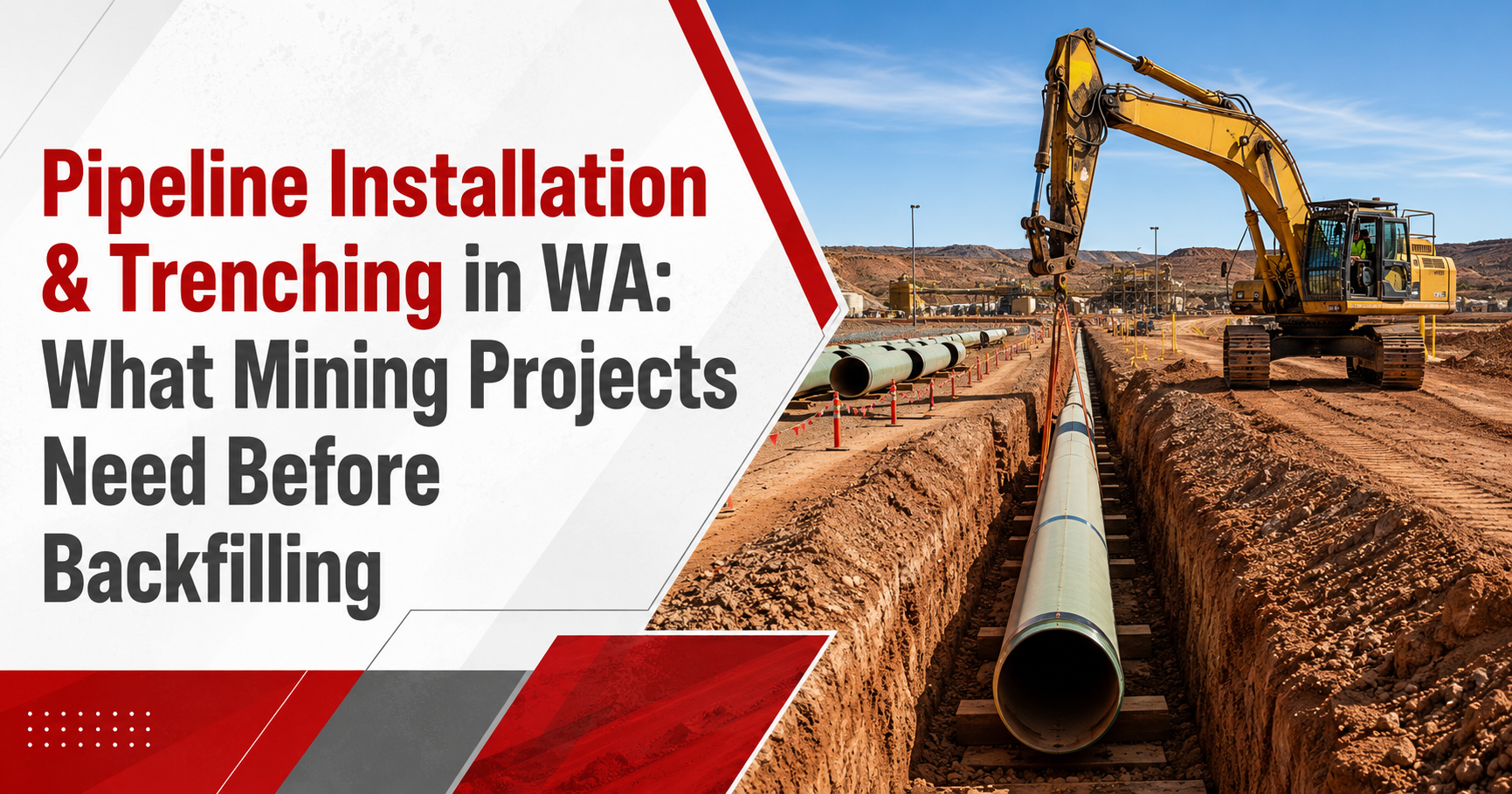
Pipeline Installation & Trenching in WA: What Mining Projects Need Before Backfilling
Pipeline construction can appear straightforward from outside the work area.
Excavate the trench. Position the pipe. Backfill it.
In practice, successful Pipeline construction depends on far more than those three steps.
Trench alignment needs to be correct. Existing services need to be identified. Groundwater may need to be controlled. The base needs to be prepared. Bedding needs to provide suitable support. Pipework must be installed to the design requirements, and backfill and compaction need to restore the ground properly.
For project teams comparing pipeline installation services WA, these activities should be viewed as one connected civil construction process rather than separate tasks.
This is particularly relevant across mining Western Australia, where long distances, remote mobilisation, heavy equipment movements and operational site requirements can make poor sequencing expensive.
Core Civil Mining currently showcases a Pilbara pipeline and civil earthworks project involving trench excavation and pipeline preparation, controlled bedding, backfilling and compaction, material handling and site reinstatement.
View Core Civil Mining Projects
What Is Pipeline Trenching?
Pipeline trenching is the excavation and preparation of a corridor that allows pipework to be installed at the required alignment, depth, level and cover.
Depending on the project, trench construction may need to account for:
- Pipe diameter
- Pipeline alignment
- Required depth and cover
- Trench width
- Soil and rock conditions
- Groundwater
- Existing underground infrastructure
- Crossings
- Access requirements
- Bedding material
- Backfill specifications
- Future surface use
The trench is therefore not simply an empty space where a pipe is placed.
It forms part of the physical support system around the installed asset.
Stage 1: Understand the Pipeline Corridor Before Excavation
Pipeline work should begin with information, not excavation.
Before plant starts digging, project teams need to understand what exists within and around the proposed corridor.
That can include:
- Survey information
- Approved design drawings
- Existing utilities
- Current ground levels
- Ground conditions
- Pipeline crossings
- Groundwater
- Access constraints
- Nearby structures
- Environmental requirements
- Future construction areas
Existing underground infrastructure may include electricity, telecommunications, water, drainage, gas or existing pipeline assets.
Before You Dig Australia provides a national referral service through which project teams can request information from participating underground asset owners before excavation.
Before You Dig Australia – Safe Excavation Guidance
Plans alone do not remove the need for project-specific locating and safe excavation controls, but identifying potential underground networks early helps teams plan the work more effectively.
Electricity and Underground Utility Coordination
Pipeline corridors sometimes cross or run beside electrical infrastructure.
Where this occurs, project teams may need information from asset owners or relevant electricity providers before excavation begins.
This is especially important where civil trenching interacts with:
- Underground cables
- Electrical conduits
- Communications
- Water infrastructure
- Existing process lines
- Other utility corridors
The objective is not simply to avoid damaging another service.
Knowing where existing infrastructure is located can influence trench geometry, equipment access, sequencing and crossing methodology.
Stage 2: Survey and Set Out the Alignment
Once the corridor has been reviewed, the pipeline alignment needs to be established accurately.
Survey and construction teams may confirm:
- Centreline
- Trench limits
- Reduced levels
- Required depth
- Changes in direction
- Crossings
- Tie-in locations
- Structures and interfaces
Small alignment errors can become larger construction problems when repeated over long distances.
The trench should therefore be constructed around the approved pipeline design rather than forcing the installed pipework to compensate for inaccurate excavation.
Stage 3: Excavate the Trench
Trench excavation methods depend on the actual ground conditions.
One section of a pipeline corridor may contain soft material while another may involve dense ground, rock, existing fill or wet conditions.
Equipment selection can therefore change across the project.
Typical considerations include:
- Excavation depth
- Ground stability
- Plant access
- Working room
- Existing assets
- Excavated material
- Water
- Required production rate
Core Civil Mining's Bulk & Detailed Earthworks capability includes trenching and drainage services alongside grading, excavation and GPS machine-controlled earthworks.
Coordinating these activities can help ensure pipeline preparation fits the broader project earthworks methodology.
Stage 4: Manage Trench Safety
Trenching introduces hazards that need to be considered before and throughout excavation.
Potential risks can include:
- Ground collapse
- Falling or dislodged material
- Mobile plant
- Underground services
- People entering excavations
- Water ingress
- Restricted access
- Nearby structures
WorkSafe WA's Excavation Code of Practice provides practical guidance for workplaces where excavation and associated earthworks are undertaken, including trenching and more complex excavations.
WorkSafe WA – Excavation Code of Practice
Actual controls need to reflect the site, trench, ground conditions and relevant project requirements.
Stage 5: Manage Water Before It Controls the Work
Water entering a trench can quickly change working conditions.
It can:
- Soften the trench base
- Affect bedding preparation
- Restrict plant or worker access
- Generate sediment
- Slow pipe installation
- Affect surrounding material
Where water is expected, dewatering should be considered during planning rather than after the excavation fills.
Depending on the project, water-management requirements can involve:
- Pumps
- Sumps
- Temporary drainage
- Sediment management
- Controlled discharge
- Surface-water diversion
Core Civil Mining provides dedicated Dewatering & Drainage capability across mining pits, civil platforms and infrastructure works.
Integrating water management with pipeline earthworks can help keep the trench suitable for the stages that follow.
Stage 6: Prepare the Trench Base
Once excavation reaches the required level, the base needs to be assessed and prepared.
Depending on the engineering requirements and ground conditions, this can involve:
- Removing loose material
- Correcting over-excavation
- Trimming
- Dewatering
- Placing suitable material
- Checking levels
- Preparing bedding
The aim is to create a consistent foundation for pipe installation.
Placing pipework directly onto an irregular or unsuitable trench base can create inconsistent support.
What Is Pipe Bedding?
One of the most useful informational queries for this topic is what is pipe bedding.
Pipe bedding is prepared material placed beneath and, depending on the design, around installed pipework to provide suitable support.
Its role can include:
- Creating consistent support
- Establishing required levels
- Protecting pipework from unsuitable surrounding material
- Supporting load distribution
- Creating a controlled environment around the pipeline
The correct material, thickness and installation method depend on the engineering design, pipe type and project conditions.
Water Corporation's WA pipeline standards provide useful examples of engineered trench and bedding requirements for water infrastructure. Those standards are asset-specific rather than universal mining specifications, but they demonstrate why bedding, trench dimensions and installation preparation are treated as engineered elements rather than improvised site decisions.
Water Corporation WA – Pipeline Design Standards
Stage 7: Install and Align the Pipeline
Once trench preparation and bedding are ready, installation can progress.
This stage can require coordination between:
- Civil crews
- Mechanical crews
- Survey teams
- Lifting operations
- Supervisors
- Engineers
The installation needs to maintain:
- Design alignment
- Levels
- Pipe support
- Required clearance
- Joint integrity
- Asset protection
Core Civil Mining's Structural, Mechanical & Piping capability is directly relevant here.
The website describes its pipeline-related civil work as including trench excavation, pipeline installation, bedding, backfilling and structural mechanical support for mining and industrial processing environments.
Pipeline Infrastructure and the Mining Industry Australia
Pipeline infrastructure supports many activities across the mining industry Australia.
Depending on mine design and operational requirements, pipelines may support functions such as:
- Water transfer
- Dewatering
- Drainage
- Process-water systems
- Utility infrastructure
- Site services
- Processing areas
The pipeline's engineering requirements depend entirely on the intended service.
The same principle applies to civil construction.
A short service line within an industrial plant and a long pipeline corridor through a remote mining environment require very different planning.
Core Civil Mining supports Mining Industry projects with earthworks, infrastructure and civil capability across Western Australia.
What About Underground Mining?
Pipeline and utility infrastructure can also be relevant to underground mining environments.
The installation methodology can differ substantially from open surface trenching because access, space, ground conditions, operational interfaces and engineering requirements may be different.
It is important not to confuse general pipeline trenching with underground-mine construction.
The actual methodology needs to follow the mine design, engineering scope and site-specific requirements.
For surface pipeline corridors supporting mining operations, however, the same civil fundamentals remain important:
planning → excavation → water management → bedding → installation → backfill → compaction → reinstatement
Stage 8: Verification Before Backfilling
One of the biggest mistakes in pipeline construction is treating backfill as the immediate next step after pipe placement.
Before the asset disappears underground, the project may require:
- Survey verification
- Inspection
- Joint checks
- Testing
- Engineering approval
- Client hold-point release
Requirements vary according to the specific pipeline and project.
The important principle is to make sure required verification is complete while the installed asset is still accessible.
Stage 9: Controlled Backfilling
Backfilling is not simply pushing excavated material back into the trench.
A controlled process may include:
- Initial placement around the pipe
- Suitable surrounding material
- Layered backfill
- Moisture conditioning where required
- Compaction
- Final fill
- Surface preparation
Material suitability matters.
Excavated spoil that is appropriate for one part of the trench may not be suitable immediately around the pipeline.
Oversized rock or unsuitable material should not automatically be reused simply because it is already on site.
Stage 10: Compaction After Pipeline Installation
Once backfilling progresses, the surrounding material needs to reach the condition required by the project specification.
Poorly controlled backfill can settle after construction.
Settlement may affect:
- Roads
- Hardstands
- Access tracks
- Drainage
- Structural areas
- Finished ground levels
- Future maintenance access
The compaction requirement can change depending on where the pipeline is located.
For example, a trench beneath a road formation may require different reinstatement controls from a pipeline running through an undeveloped corridor.
This is why pipeline civil works should integrate with the wider earthworks package.
Stage 11: Coordinate Pipeline Backfill With Future Construction
A pipeline trench rarely exists alone.
It may cross or run alongside:
- Roads
- Drainage systems
- Concrete foundations
- Electrical infrastructure
- Processing plant
- Hardstands
- Other pipelines
- Future development areas
Poor sequencing can result in completed works being reopened later.
Where practical, the project sequence should consider future infrastructure before final reinstatement.
Core Civil Mining's broader Capabilities allow earthworks, drainage and pipeline-related civil activities to be considered as connected project stages rather than unrelated scopes.
Material Handling Can Make or Break Productivity
Trench excavation generates material quickly.
Project teams then need to decide what happens to it.
Material may be:
- Suitable for backfill
- Unsuitable for reuse
- Temporarily stockpiled
- Transported elsewhere
- Replaced with imported material
Bedding material may also need to be brought to the work front at the correct time.
Poor stockpile positioning can create double handling.
That increases:
- Excavator time
- Loader movements
- Truck movements
- Fuel use
- Congestion
- Project duration
Material planning should therefore start before major trench excavation begins.
Stage 12: Site Reinstatement
Pipeline construction does not finish when the pipe disappears underground.
The corridor needs to be left suitable for its intended future use.
Site reinstatement can involve:
- Final backfill
- Compaction
- Grading
- Drainage restoration
- Road reinstatement
- Surface preparation
- Topsoil replacement where applicable
- Removal of temporary work areas
- General clean-up
Core Civil Mining's current Pilbara pipeline project specifically identifies material handling and site reinstatement as part of its civil scope.
Explore Core Civil Mining's Project Work
Pipeline Installation in Remote Western Australia
Remote project delivery adds another layer of planning.
For pipeline installation services WA, particularly in mining regions such as the Pilbara, project teams may need to organise:
- Plant mobilisation
- Operators
- Fuel
- Water
- Spare parts
- Maintenance support
- Bedding and fill materials
- Communications
- Accommodation
- Site access
When a project is far from metropolitan support, small supply problems can create much larger delays.
Forward planning becomes part of production.
Pipeline Works Should Connect With the Wider Mine Plan
Pipeline infrastructure can interact with:
- Bulk earthworks
- Mine roads
- Drainage
- Dewatering
- Structural pads
- Processing infrastructure
- Utilities
- Tailings-related works
That means the best pipeline methodology is not necessarily the one that excavates the trench fastest.
The better methodology is the one that allows the complete project to progress with minimal rework.
The construction sequence might look like:
Survey → Service Identification → Earthworks → Trench Excavation → Dewatering → Bedding → Pipeline Installation → Verification → Backfilling → Compaction → Reinstatement
The precise methodology will depend on the project.
The principle is coordination.
What Should You Look for in Pipeline Installation Services WA?
When assessing pipeline installation services WA, project teams should look beyond hourly equipment rates.
Trenching Capability
Can the contractor handle the ground conditions, required geometry and production volumes?
Civil Earthworks Capability
Can excavation, grading, material handling and reinstatement be coordinated?
Dewatering Capability
Can water-management requirements be integrated into the trench work?
Bedding Preparation
Can pipe support and trench preparation follow the relevant project requirements?
Backfill and Compaction
Can the corridor be restored to the required standard?
Mining Experience
Does the contractor understand active and remote mining environments?
Safety Systems
Are excavation, underground-service and mobile-plant risks actively managed?
Remote Project Capability
Can plant, workforce and support requirements be maintained across regional WA?
Project Coordination
Can civil works integrate with survey, engineering and mechanical crews?
The cheapest excavation price does not necessarily produce the lowest overall project cost if poor sequencing creates delays, double handling or rework.
Common Pipeline Trenching Mistakes
Excavating Before Checking Existing Services
The proposed corridor should be understood before heavy excavation starts.
Treating Groundwater as a Surprise
Where water is foreseeable, dewatering should form part of the methodology.
Poor Trench Base Preparation
The installed pipe needs consistent support.
Incorrect or Uncontrolled Bedding
Bedding requirements should come from the relevant engineering specification.
Installing Before Levels Are Verified
Alignment problems become harder to correct later.
Covering the Pipeline Before Required Checks
Testing and inspection should be coordinated before backfilling.
Poor Compaction
Future settlement can affect roads, drainage and operating surfaces.
Ignoring Reinstatement
The civil scope does not finish when the trench is closed.
Build the Trench Around Long-Term Pipeline Performance
The most important pipeline construction decisions happen before final backfill.
Excavation creates the working environment.
Dewatering helps maintain suitable trench conditions where required.
Bedding supports the asset.
Installation establishes alignment.
Backfill protects the pipeline.
Compaction restores the surrounding ground.
Reinstatement prepares the corridor for future operations.
When those stages work together, pipeline installation becomes a complete civil construction process rather than a simple excavation task.
Core Civil Mining Pipeline & Civil Capability
Core Civil Mining delivers civil and mining services across Western Australia.
Relevant website capabilities include:
- Trench excavation
- Pipeline installation
- Bedding
- Backfilling
- Compaction
- Material handling
- Site reinstatement
- Bulk and detailed earthworks
- Dewatering and drainage
- Structural and mechanical support
The company's current website also showcases pipeline installation and associated civil earthworks in Pilbara mining conditions.
View Core Civil Mining Capabilities
Planning Pipeline Installation or Trenching in WA?
Pipeline projects perform better when excavation, drainage, installation, material handling and reinstatement are planned as one connected scope.
If your upcoming mining, industrial or infrastructure project requires pipeline trenching, civil earthworks, bedding, backfilling, dewatering or related support, discuss the requirements before mobilisation.
Frequently Asked Questions
What is pipeline trenching?
Pipeline trenching is the excavation and preparation of a corridor that allows pipework to be installed at the alignment, depth and level required by the project design.
What is pipe bedding?
pipe bedding is a common question during pipeline planning. Pipe bedding is prepared material placed beneath and, depending on the design, around pipework to provide suitable support in accordance with engineering requirements.
Why is pipe bedding important?
Correct bedding can provide consistent support, help establish pipe levels and separate the asset from unsuitable surrounding trench material.
What is included in pipeline installation services WA?
Depending on the project, pipeline installation services WA can involve set-out, trench excavation, dewatering, trench preparation, bedding, pipe installation, backfilling, compaction and site reinstatement.
Why might a pipeline trench need dewatering?
Groundwater or surface water can affect the trench formation, bedding and installation conditions. Temporary dewatering may be required to maintain a suitable working area.
How deep should a pipeline trench be?
There is no single correct depth. It depends on pipe design, required cover, crossings, ground conditions, existing infrastructure and applicable project specifications
Why is pipeline backfill compacted?
Compaction helps limit settlement and restore the trench corridor to the condition required for future site use.
What should happen before excavating near electrical services?
Existing infrastructure should be identified and relevant plans and asset-owner requirements reviewed. Depending on the location, coordination may involve network operators or electricity providers, and additional utility locating may be required.
What should I look for in a pipeline contractor in WA?
Look for relevant trenching and earthworks experience, appropriate plant, water-management capability, safety systems, material-management experience, compaction capability and the ability to coordinate civil works with mechanical, survey and engineering teams.